Printify
In 8 months I reversed an 18% decline in new Pop-Up stores while navigating a forced business model change during peak season.
E-commerce, B2B2C
7 months
2025

At a glance
Redesigned the core experience, leading to a 9% increase in new stores created, reversing a 6-month 18% decline.
Designed a new verification process that 91% of active merchants completed.
Only 4% of Support inquiries about the redesign.
Established product ownership for the team through a guided flow adopted across all sales channels.
Cross-team coordination across design, engineering, product, support, and marketing.
Team setup
As the sole product designer, I worked with a PM, 6 developers, and the Head of Product.
I collaborated with other teams because the Pop-Up store is an e-commerce product built inside Printify’s print-on-demand platform. It became a real constraint when I discovered our core journey was partly owned by another team.
Our customers are small businesses and creators who chose Pop-Up Store for its simplicity. Preserving that simplicity through a forced business model change became the core design challenge.
Merchants weren’t reaching the value of Pop-Up stores
When I joined, new Pop-Up store creation had declined 18% over six months. Most merchants would create a store, but ended up using other sales channels.
The PM and I dug into analytics, surveys, support tickets, and session recordings. It became clear where the journey broke down.
33% didn’t understand Pop-Up’s value or how it worked.
24% couldn’t find how to publish products.
16% finished onboarding without creating a product.
11% encountered technical issues.
I did an audit of the end‑to‑end journey and found that these weren’t isolated usability issues. An intrusive modal redirected merchants away in the middle of creating a Pop-Up store, screens collected information we never used, and bugs sometimes hid the main CTA.
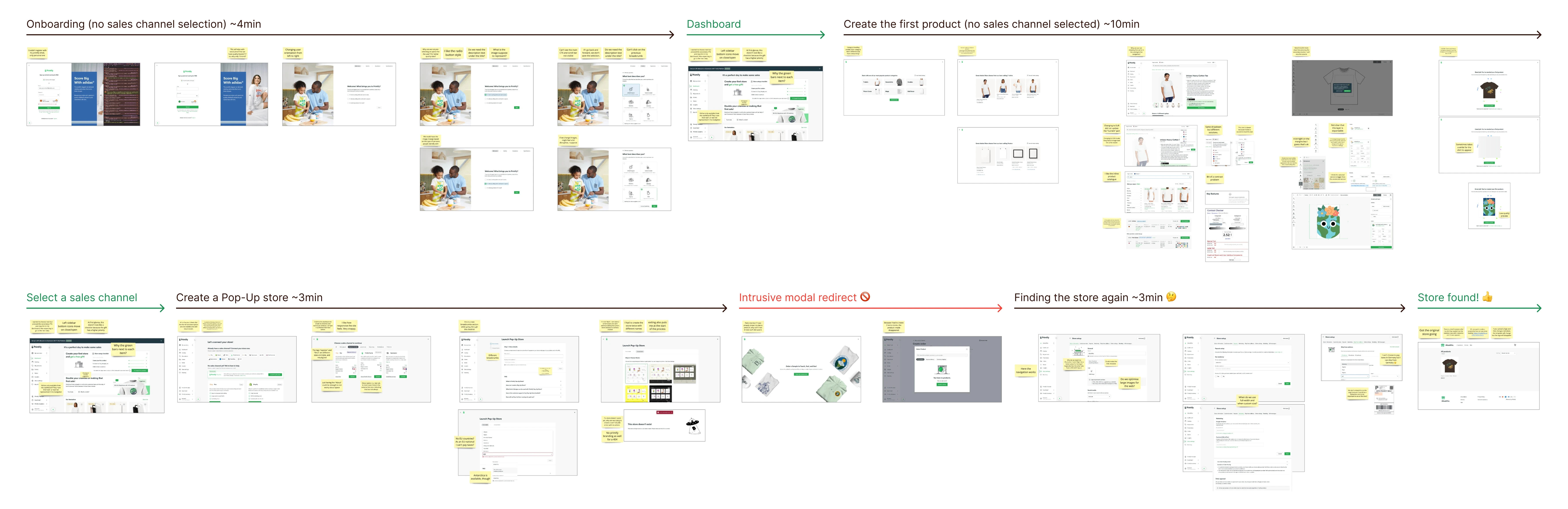
The flow was fragmented, distracting and was not working in favour of Pop-Up store.
I took the data to the PM and Head of Product, connecting the drop in store creation to concrete failures in the product experience.
Pop-Up hadn’t been a roadmap priority because it had fewer users than other sales channels. My findings combined with the upcoming brand launch, pushed it to the top of the roadmap.
We split the work into two releases:
Redesign the core journey to help more merchants reach publishing.
Build verification for the coming business-model change.
Successful merchants publish 5 or more products
No one had defined what a successful merchant looked like, so I mapped the actions on the platform and looked for the ones that correlated with sales.
Merchants who verified within 24 hours, uploaded their logo, and published 5+ products were far more likely to make sales. That became our success metric.
We had no ownership over our core journey
Digging into session recordings, I found that a rogue modal from the onboarding team was redirecting merchants to a sales channel they hadn’t chosen. Because the codebase belonged to another team, even small bug fixes required negotiation.
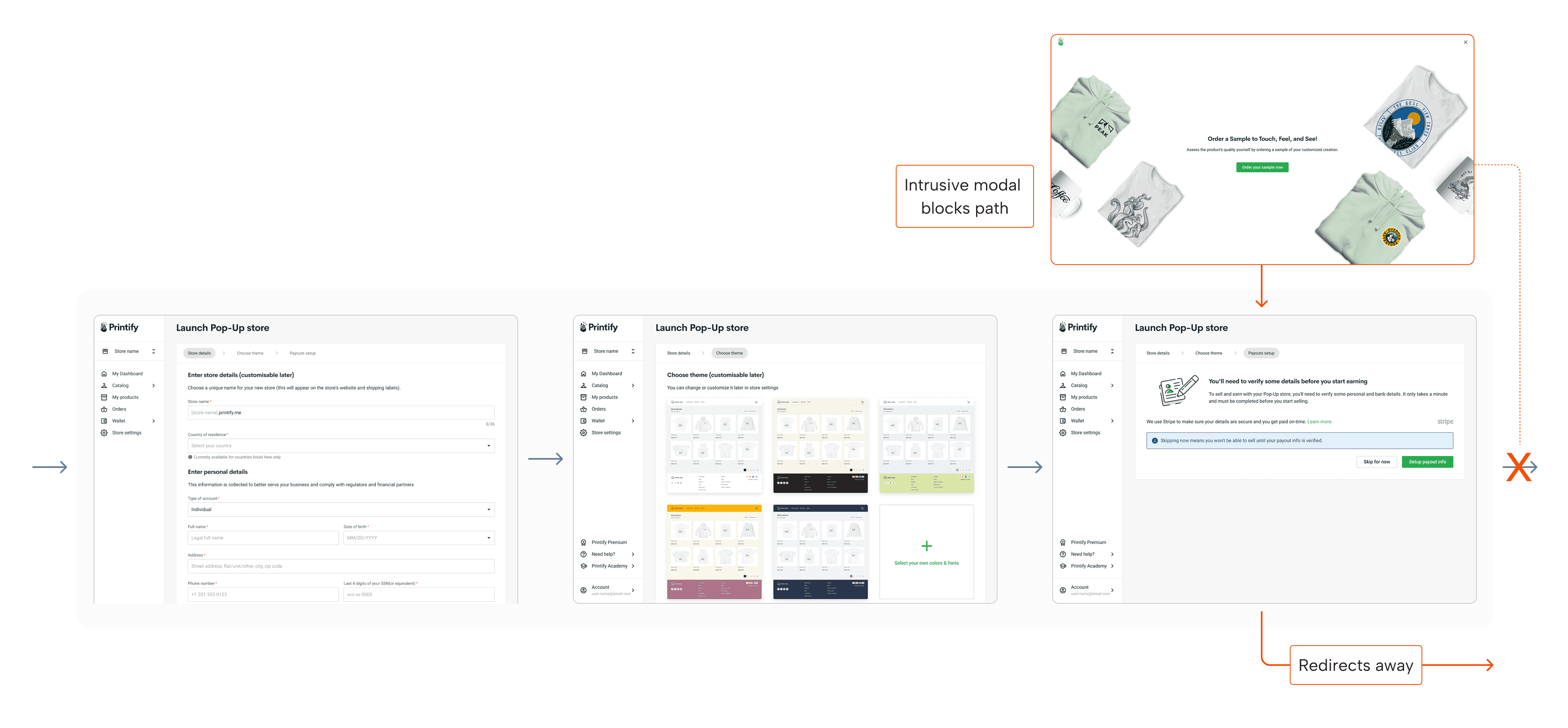
To create a journey we could actually improve, I proposed a small Success step at the end of store creation. It was scoped enough to get buy-in, and it gave us a controllable surface inside a flow owned by onboarding.
We could now independently make changes and run experiments on the core journey.

Around the same time, Printify was going through a full rebrand and product teams had started adopting jobs-to-be-done thinking.

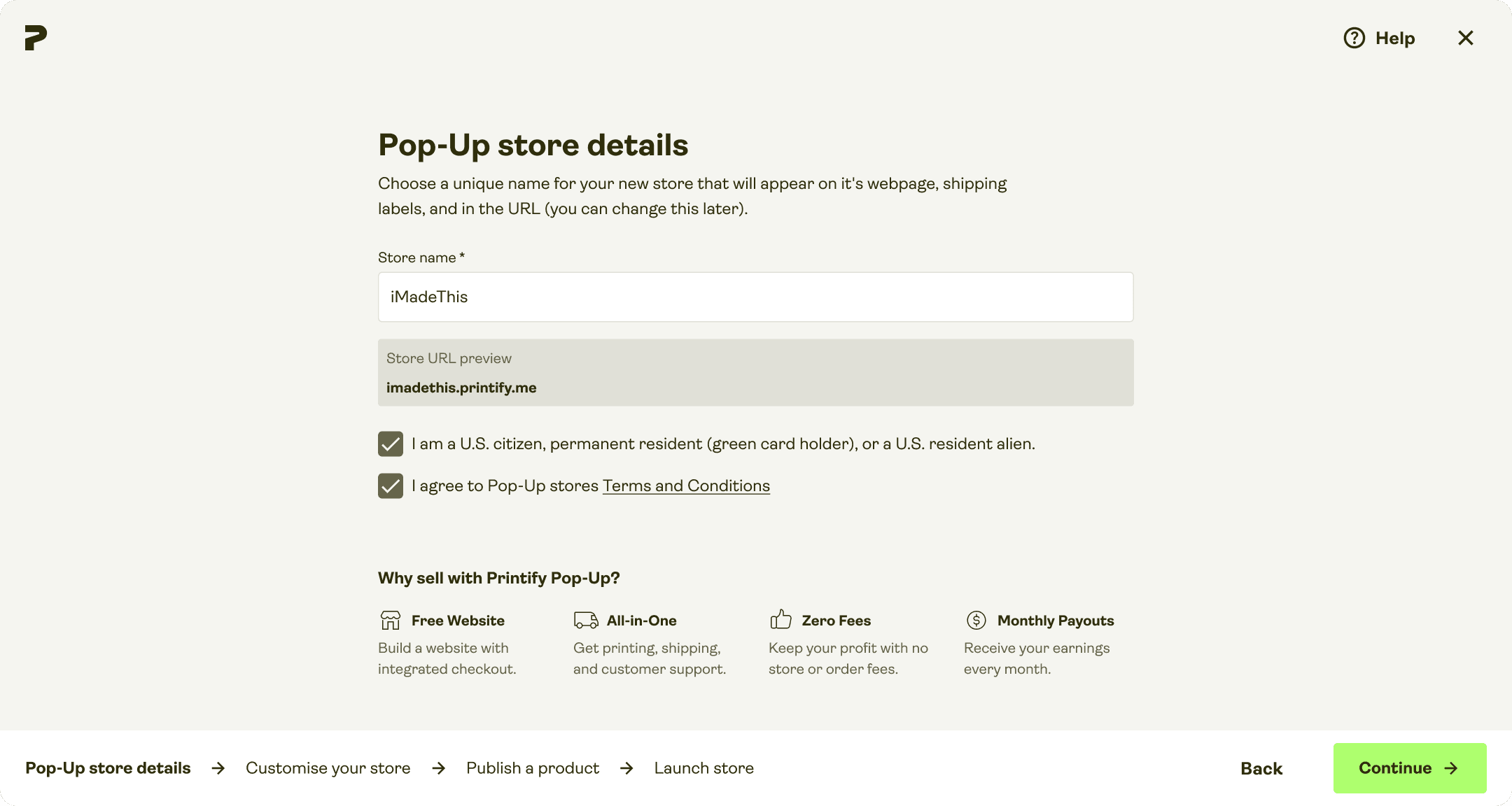
Alongside other designers, I explored how these principles could be used to guide merchants through each job — from creating a store to publishing their first product and celebrating that milestone.
That pattern became the guided flow used across all sales channels.
The result was a 9% increase in new stores created, reversing a six-month 18% decline.


Once we had a guided flow merchants could actually complete, the next challenge was more urgent.
Your store will be disabled in 90 days
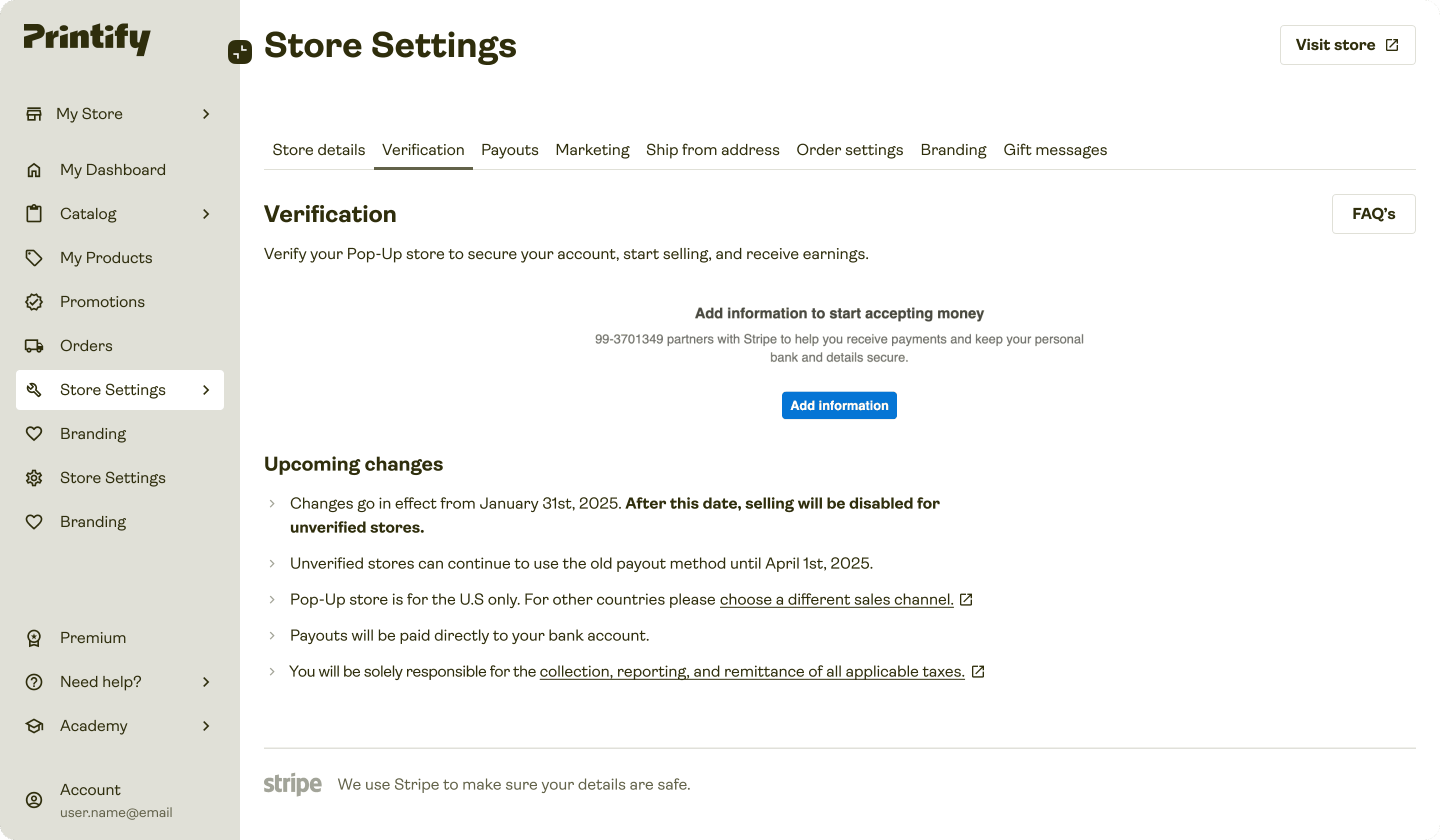
Compliance requirements forced Printify to switch payment providers, which meant all merchants had to verify their identity, pass KYC, and manage their own taxes. They had 90 days to migrate or stop selling.
The biggest risk was that Stripe could flag legitimate merchants with no recourse, putting their businesses at risk overnight.
With peak shopping season around the corner, we used Stripe’s pre-built components because we needed to ship quickly and the integration had to stay technically feasible and stable.
That meant verification opened in a new window and we couldn’t fully control the experience, but it still let us apply our brand typography and colors to make it feel native.
Merchants never asked for this change, so I took responsibility to make the transition as seamless as possible.

I split the experience by audience: active merchants needed urgency because of the deadline; new merchants needed a calm explanation of the process ahead.
Even with an imperfect process, 91% of active merchants successfully completed the verification process.

Nudging merchants to act
I proposed a proactive communication strategy with persistent banners and modals guiding merchants to verification.
Messaging adapted based on how many products they had published: more products meant more encouraging messaging.
Merchants who started but didn’t finish got reminders, and time-triggered modals appeared one month and one week before the deadline. Only one banner was visible at a time.

Nudging merchants to act
The banners had to work across every platform surface, so I ran workshops with engineers to map the logic, structure, and edge cases before pitching it to other teams.
The PM and I got other teams to agree to our team owning banner behavior inside their codebase. That gave us direct control over banner fixes instead of waiting on another team.
I also established an ongoing process with Support and Marketing for help articles and email campaigns.

Disabled stores destroy trust
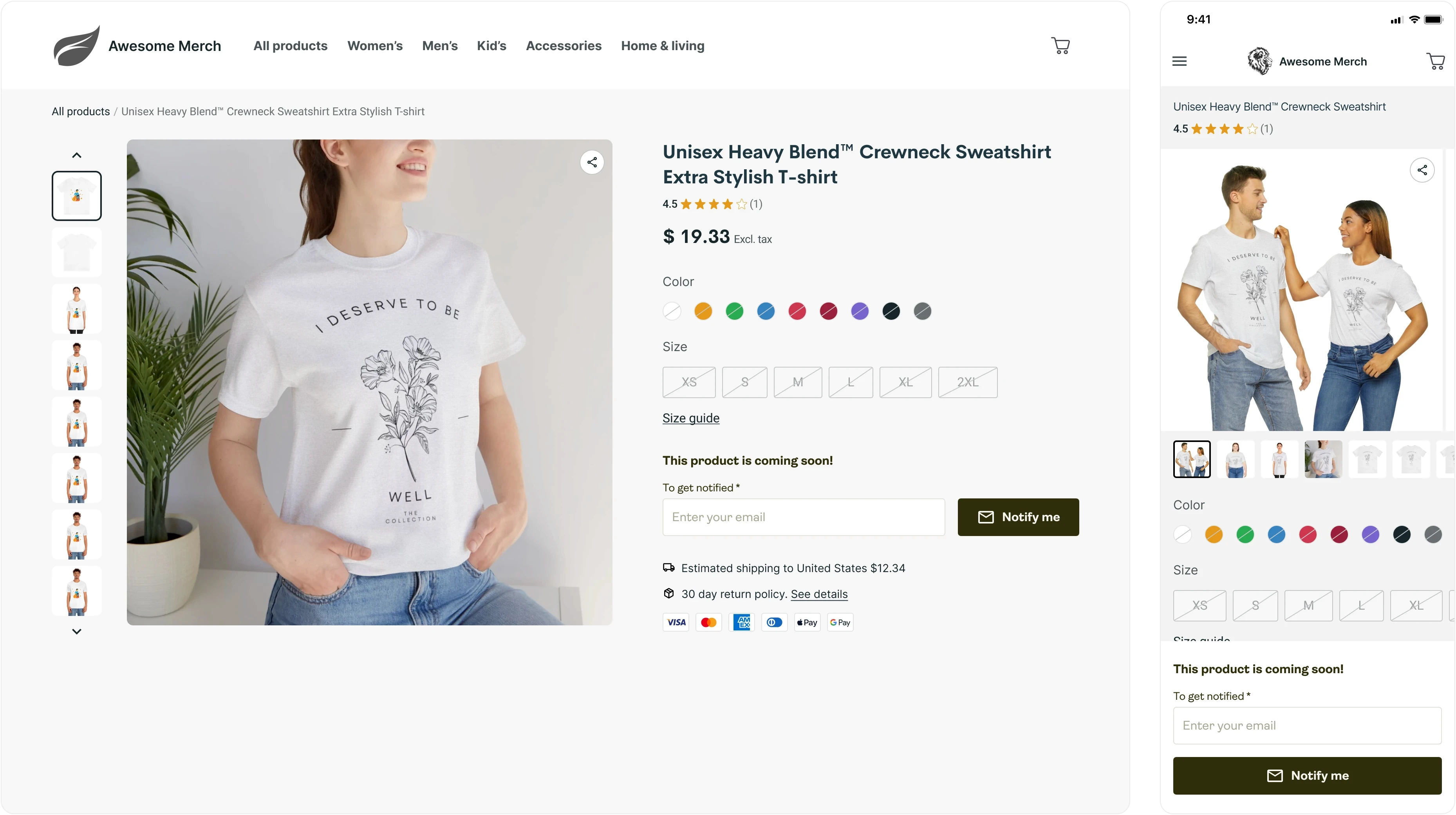
When a store was disabled, a warning banner appeared at the top. For visitors, that made the store look untrustworthy.
I noticed that if merchants saw traffic to their disabled store, they’d have a reason to complete verification. So I replaced the warning with an email signup field and a dashboard widget showing visits and emails collected.
The first release showed what broke
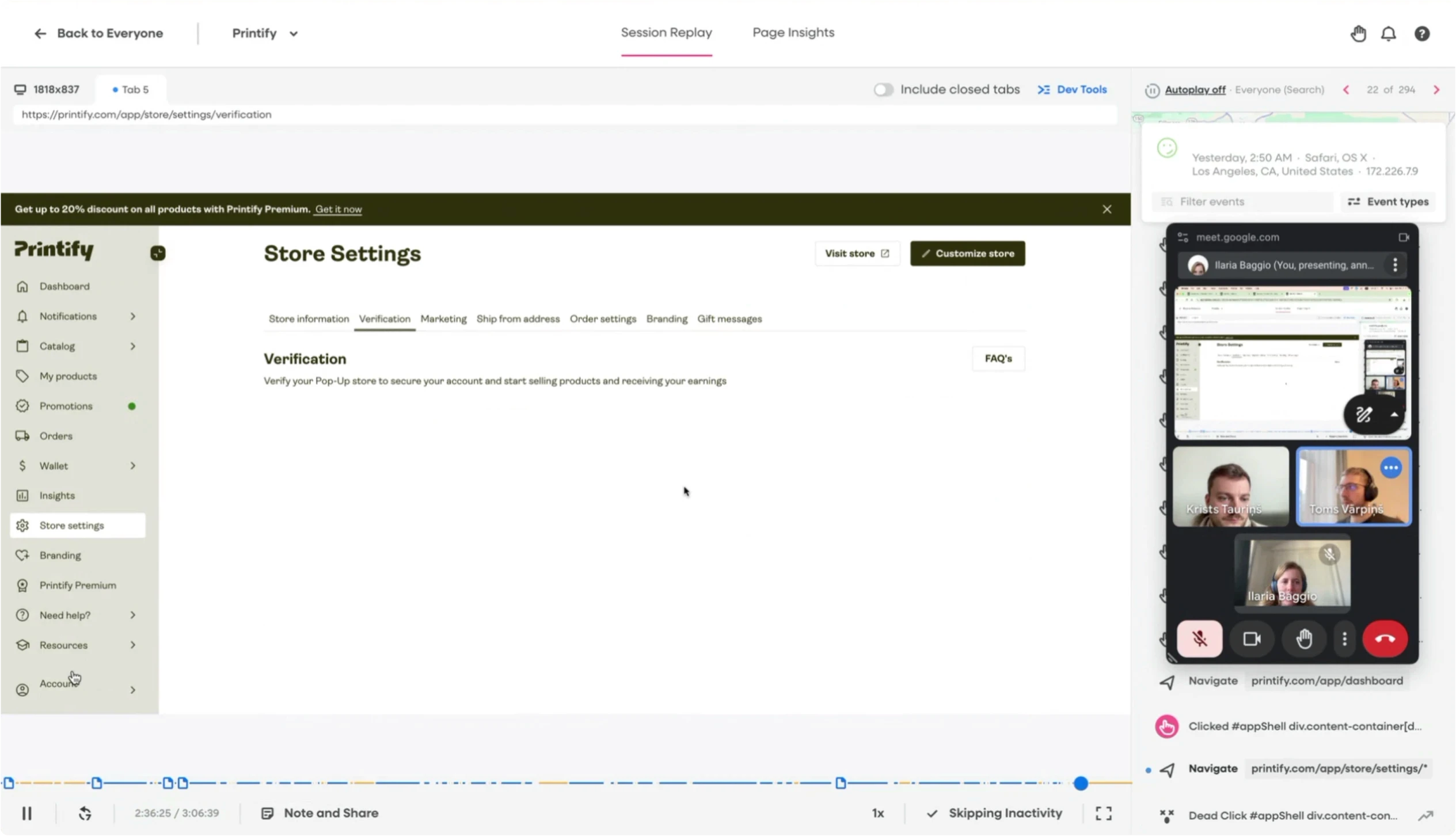
We shipped to 5% of merchants behind feature flags. I reviewed Fullstory sessions weekly with the PM and team.
79% of merchants who published a product started KYC.
63% completed within 48 hours.
32% abandoned on the first try.
The rollout exposed bugs in the banners, CTA, and Stripe flow. Fullstory didn’t record inside Stripe, leaving the critical step invisible.
After fixing these issues, 91% of active merchants completed verification.
Reflections
The small Success step mattered more than I expected. It reduced the fragmentation and gave merchants a real sense of completion.
The 91% completion rate also beat my expectations. I knew active merchants wanted to keep selling, but I didn’t expect the process to land that well in the first two months after release.
Lack of ownership over the core journey was the biggest constraint. When critical parts of the flow live across teams, even minor changes become coordination-heavy and slow to ship.
Workshops with engineers and close PM collaboration helped us arrive with a plan and pitch it with confidence.